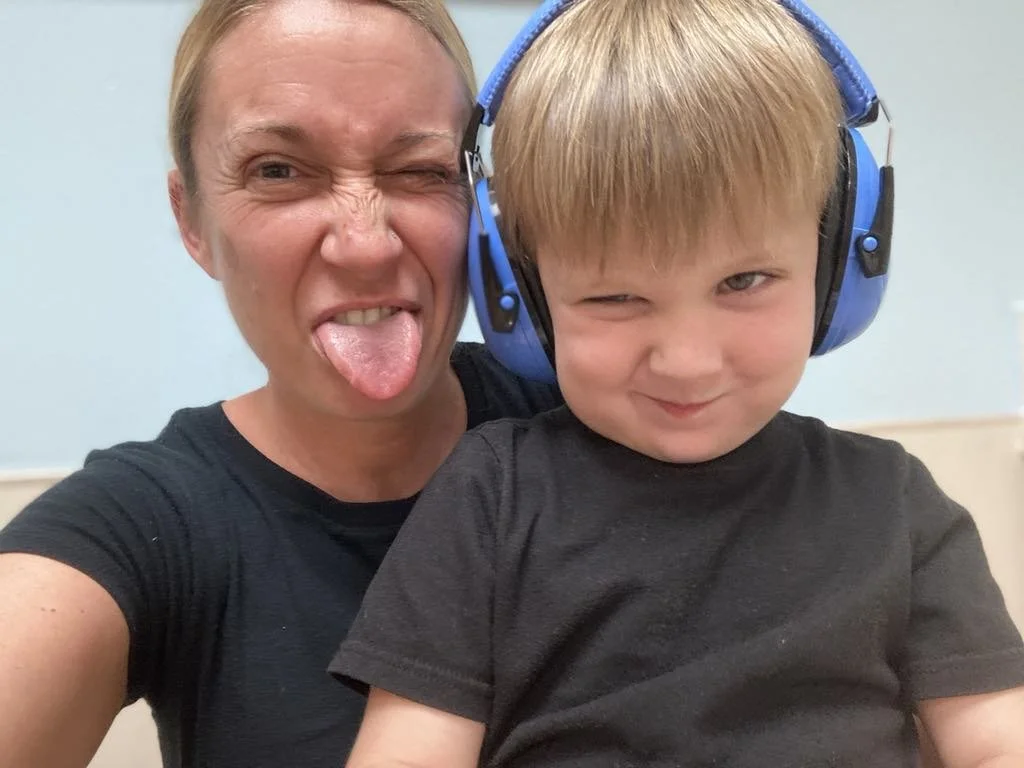
“You will be leaving here today with an Autism diagnosis”. The single sentence uttered by the developmental pediatrician that took a year to finally get into. It was the first appointment in 3 years for my child where I actually felt seen and heard. That my concerns weren’t just brushed off with a simple “he will grow out of it” or “a lot of kids do that,” or “ you need to learn better parenting skills” (yup, if you can actually believe that I was told that at an evaluation for my kiddo). The words came with a sigh of relief and a heavy heart of sadness. We weren’t surprised by the diagnosis at all. We had suspected for a long time but we were waiting to pursue a diagnosis until he got older. He has a complicated history and I wanted to make sure we got an accurate diagnosis so that we could make sure he was getting the right therapies. So much of it overlaps with trauma and in utero exposure, but the longer time went on it became clear to us that these things simply weren't things he was going to grow out of. As a baby, he was beyond easy. He would just sit and swing for hours and giggle when you would look at him or talk to him, he always just seemed super content, minus some severe eczema. And then things just started escalating. He was mad all the time, crying all the time, and then the head-banging started. Every little toddler fit would turn into him banging his head aggressively on the floor. By the age of 2, he only had a few words. We started him in speech therapy, and now he doesn’t stop talking. Thankfully, the headbanging has stopped, but the general temperament is the same. Everything has to be a certain ‘right’ way, but that right way is different every day, and sometimes, he doesn’t even know what the right way is. There is a general rigidity and lack of flexibility that makes completing everyday tasks extremely difficult and transitions basically impossible. He is easily overstimulated but can’t communicate that. It’s taken us the better part of 2 years, but we are finally in a place where things are manageable and we don’t feel like we are losing it every day. I joke on a regular basis that I was not meant to be a special needs mom. I simply don’t have the patience for it, but I guess the universe had other plans for me. Because now I’m in the thick of it and learning just as much about myself as I am about him.
While I’ve hinted that he has autism, I haven’t yet actually shared that diagnosis until now. April is Autism Awareness/Acceptance Month and now, as an ASD momma, that carries some weight. We live in a time where people are thankfully more aware, but we have seen firsthand that there is still so much more awareness and acceptance needed for these kiddos whose brains are just wired differently. It’s something I have to remind myself every day, so I dont’ expect that to come naturally to others either. Sadly, what I’ve found is that the ASD world is very similar to the foster care world. There are tons of kids, lots of needs, lack of resources, and lack of understanding and knowledge. It’s lonely in the way that the only people who truly understand are the ones who have lived it. It’s exhausting and heart-wrenching and also so full of hope.
So here I stand on the other side of that one sentence. It’s been a challenging 6 months post-diagnosis. I thought it would open up a ton of doors, and instead, we are finding we are still oddly stuck in the middle with no place to go. Our little guy is highly functioning, which I am thankful for, but there isn’t a space for him. School has been a fight that we sadly feel like we can’t win, resources in our area are basically non-existent, and while things have improved, we recognize he needs so much more than he is getting.

Photo by : Tiny House Photo
Doing what I know to do, I dove headfirst into the research once we got our diagnosis. Autism at its root, is a medical condition. We tend to treat it like a behavioral disorder in this country, which isn’t necessarily a bad thing; those therapies are needed as well, but when we look at it from a medical position, there is so much more promise for tangible change. I’ve seen it first-hand in our kiddo. After reading tons of research articles, I made some simple supplement changes for him, and we saw huge results. It wasn’t a cure, but it sure provided more regulated days. More regulation made it clearer for us to see the ups and downs and better understand and see his triggers, and also allowed us to make appropriate accommodations. We now have more good days than bad and are learning how to meet him where he is at. I’m advocating like hell for the services he needs ( a skill I thankfully learned as a foster parent) and finally feeling like I can start sharing what I’ve learned and what has helped him.
Will it help every child with autism? No, probably not, because each one of them is very different. Do I believe it could help many? yes! When we received our diagnosis, I was told ABA therapy and medication. Now, for those of you who know me you know that medicating my toddler was not an option I would even consider. ABA is the gold standard for ASD kiddos, but that comes with a but. It’s gotten a bad rap over the decades, it’s not perfect, it can be great, or terrible. It can be extremely traumatic if not done correctly, and finding a trauma-informed ABA practitioner is basically a unicorn ask. In-home ABA would be ideal for our little one, but it doesn’t exist where we live. Our only option is a large ABA center and after finally getting a spot after a 6-month long wait list, we decided it wasn’t the right fit for him. While we are still on the search for the right therapy options, I needed to do something now. I knew there was some correlation between MTHFR and autism, so I started there.
For those of you not familiar with MTHFR it's basically a gene that is responsible for folate metabolism in your body, also known as B9. I’m not going to get super medical because I don’t think that’s helpful, but at the basic level, we consume a ton of folic acid as a society. It’s in most of our breads, grains, and cereals in this country as well as a handful of other fortified foods and supplements. Most moms are familiar with folic acid because we are told to make sure we have a ton of it while pregnant to prevent neural tube defects. While that research stands true the form we are all ingesting is folic acid. If you have the MTHFR gene snip, then your body doesn’t actually metabolize that folic acid into its usable form of folate. Now, I’m sure most of you are thinking no big deal, I dont’ have this gene snip, however 50% of the population does and doesn’t know it. The research shows that up to 80% of kids diagnosed with autism have MTHFR. That’s not to say that having the MTHFR gene causes autism; however, ASD kiddos supplemented with the appropriate form of folate show less ASD symptoms. Cure for Autism? Not exactly, but again if you look at it from a medical diagnosis, that has to mean there is a medical reason, right? Vitamin deficiency actually makes a lot of sense. And then if you consider the standard diet of an ASD kid, which is mostly processed carbs (high in synthetic folic acid) it makes even more sense. So what do we do? In our case, we started supplementing with methalyed folate and folinic acid. Within just a week we saw a shift in our kiddo. Better regulated, calmer, less outbursts. There have been studies that also show improved language as well for ASD kiddos. Now, we actually haven't had our child tested so we don’t even know if he does have the MTHFR gene, but if he doesn’t there is no harm in taking these supplements, so I figured it was worth a shot.
Another notable component of MTHFR is that it affects your body's ability to detox properly. So while I do not by any means want to make this a post about whether or not vaccines cause autism, I do think this is important to know. I think everyone can agree, whether you're pro or anti-vaccine, that vaccines have a host of different ingredients, not all of which are great. The average body detoxes from the not-so-great ones so it's not really a concern, but if you are dealing with a child whose body doesn’t appropriately detox, you’d have a build-up of toxins. Add in that most children on the spectrum suffer from constipation, and you’ve got even more toxin buildup. Decrease toxin buildup and toxin exposure, and see the pathways open up.
This is simply part 1 of what I want to share. I’m still learning, and I plan to share as I go. Thankfully, MTHFR was something I was already aware of and educated on for almost a decade at this point, so it wasn’t new to me, so I had a great starting point. I had actually been tested for it years ago and have it myself. But along the way over the last decade, I was shocked to see how many doctors weren’t aware of it at all, or if they didn’t have any clue on how things should be approached medically with someone who does have it. Even our developmental pediatrician, when I asked her about herbal supplements for him, hoping to find something to help just calm his nervous system, she noted that the only thing that had been studied with benefit was folic acid if I wanted to start there. But again, no mention of the type of folic acid I should give him so the average parent would actually just be adding in more folic acid when they need a converted form.
Ok, so if your child is on the spectrum. What can you do?
Check and make sure that none of their current vitamins or supplements contain folic acid. Limit foods that contain added synthetic folic acid like cereal and breads.
2. Switch them to a methylated folate or folinic acid supplement. These work slightly differently, and some kids do better on one than the other, so it’s best to try them both separately for your child.
3. Do regular Epsom salt baths to help detox and make sure they are having regular bowel movements.
4. While there are a ton of resources and information out there about Autism, I have found that they are almost all behavior-based. Dr. Jared Skowron is one main source that I have found that addresses autism from a medical perspective and backs it all with current research. His podcast is FULL of incredible information, and his line of supplements are a really great option for a clean product specifically designed for kids on the spectrum.
5. Broccoli sprouts are the only food item that has been shown to actually help children on the spectrum. My kiddo won’t eat them as is, so I add them into smoothies and popsicles. They are an insanely nutrient-dense food that has benefits for everyone but especially kiddos on the spectrum.
As we travel through this journey, I plan to share more with you as I go. What works, what doesn’t, what I’m learning in the process, what I’m reading in the research, what we are doing for therapy and for school.
A few last things I want to note…
I am not by any means an expert on autism, simply a parent learning as I go. While I am a registered dietitian, I am not a doctor, though I don’t really feel like those credentials hold much weight anymore.
I believe that there is a time and place for pharmaceutical medications, but I think that natural, herbal, vitamin, and food approaches should be exhausted first.
If your child is currently taking any medication, please be sure to check with your doctor before starting any new supplements.
In our child’s case prior to even suspecting Autism he was already avoiding added sugars, artificial colors, and preservatives. We had also done a large period of time of following a gluten free diet as well as a dairy free one. I do believe making those dietary changes is a great step.
And because I’m sure someone will ask…my child who is autistic is partially vaccinated. He received a total of 5 vaccines the day he was discharged from the NICU at 3.5 months old prior to being placed with us. He has not received a single one since. I do personally believe that vaccines have the ability to cause Autism, but I do not think that is the singular cause.
Outside of autism, some other things MTHFR can effect to consider:
If you are pregnant, you are typically told to take a prenatal vitamin with folic acid; you should be taking one with methylfolate. A lot of prentals have jumped on this train, but a lot still have not, and most OB’s don’t know this information.
B vitamin deficiency has been linked to miscarriage. Having the MTHFR gene would then in turn increase your risk of miscarriage since your body doesn’t metabolize B vitamins the same way. In a time where miscarriage rates and infertility are on the rise, I can’t help but think about how much this information could help.
I mentioned it affects your body’s ability to detox, so this is something to consider when you are taking any medications or vaccines, as they would potentially accumulate and take longer to leave your body. I personally felt this after having my baby. I had hoped for a natural birth for a lot of reasons but ended up having an emergency c-section, planned for no drugs, had a lot of drugs (plus anesthesia), and I felt crappy for a long time postpartum as my body was trying so hard to get rid of all the toxins.
Epsom salt baths are a great natural way to detox and are safe to use for adults or kids.
MTHFR is genetic. Both parents have to carry the gene to pass it on to their children.
Testing is typically done with an easy and non-invasive cheek swab but it can be hard to find someone who offers the testing and it’s rarely covered by insurance.
If you are interested in any of the supplements we use in our house feel free to check out my Fullscript account. There you will find the prenatal I personally take and the supplements I give my kids. I personally only use pharmaceutical-grade supplements that are 3rd party tested. In addition to these supplements, my kids also get a handful of herbal tinctures from Earthley on a daily basis to help support their immune system and make sure they are getting all the nutrients they need.
Lastly, I want to say a HUGE thank you to our family and friends who have walked alongside of us and our little guy. We are so lucky to truly have a village of people who love on and accept our kiddo and are open to learning alongside of us.